December 12, 2025
The Voices We Don't Hear in Meetings
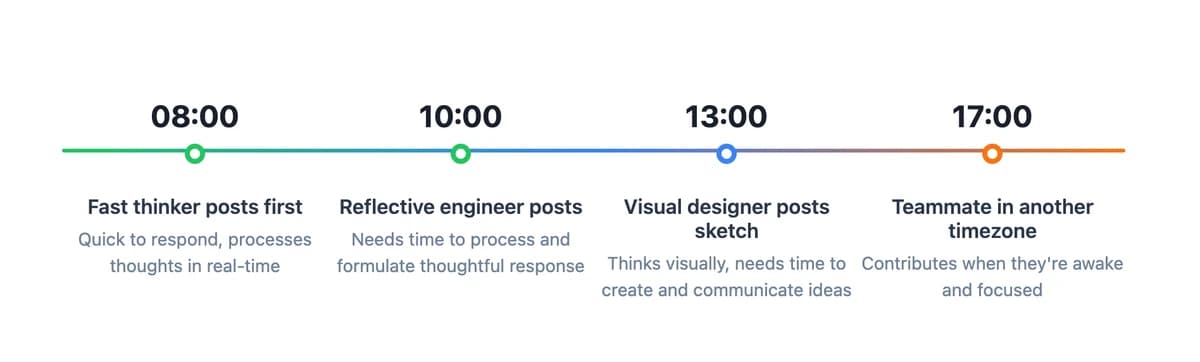
Ever notice who speaks first in meetings?
Usually the quickest thinkers, the native speakers, the people comfortable thinking out loud. There's nothing wrong with any of these traits. I'm often one of those people myself. But it's just one type of intelligence, one communication style.
And when that becomes the default mode for contribution, we miss a lot.
What We Were Missing
At Silverbucket, I started noticing patterns in our bi-weekly retrospectives. The same voices would dominate the conversation. Not because they had the best insights necessarily, but because they were fastest to articulate them in real-time. Meanwhile, some of our most thoughtful team members, people with genuinely valuable perspectives, would sit quietly.
The insights that did surface often came too late. Someone would remember a critical issue from two weeks ago, but the context had faded. The energy to fix it was gone. We were running retrospectives on a schedule, not when the learning was fresh.
It felt like we were going through the motions.
The Experiment
We decided to try something different: continuous retrospectives instead of periodic ones.
How it works: Set up an anonymous feedback form that your team can access anytime. Use automation to post new feedback items to your team channel weekly. Team members discuss in threads asynchronously, contributing when they have something meaningful to add.
Here's what it looks like in practice:
We set up an anonymous form that anyone can drop feedback into, anytime. Every week, automation picks up new items and posts them to Teams as separate messages. Team members react and discuss in threads, on their own time, when they have something meaningful to add.
No one's put on the spot. No one has to compete for air time. No one's good idea gets lost because they needed a day to think about it.
What We're Watching For
It's still early, but here's what we are looking for.
We're hoping the quieter voices will show up more. People who rarely speak in live retros might find it easier to contribute in writing. They might have plenty to say, but need a different medium to say it in.
We're hoping small wins will get celebrated in the moment rather than waiting for the next scheduled retro. When someone ships a tricky fix, the team could acknowledge it right away. This might sound minor, but recognition that happens in the moment should mean more than recognition that happens two weeks later.
We're expecting cross-team insights to flow more naturally. Because the feedback stream is visible to adjacent teams, we should start getting valuable perspectives from people who weren't in the original retro invite. The engineer from another squad who solved a similar problem. The designer who has context we didn't know existed.
And potentially, we'll build better documentation along the way. Written retrospectives create a searchable history of what we learned and why we made certain decisions. Months from now, when someone asks "why did we change this process?", we'll have an actual record instead of vague memories.
For me personally, this changed how I communicate. I write more thoughtfully now. Not because I'm trying harder, but because async communication rewards clarity over speed. You can't rely on tone of voice or quick follow-ups to fix unclear messages. You think before you hit send.
The Tension
I'd be lying if I said it was all wins.
Decision-making feels slower sometimes. When you're used to hammering out a solution in a 30-minute call, waiting for written responses over a day or two can feel frustrating. That impatient voice in my head says "we could have just jumped on a quick call."
But then I catch myself. What am I optimizing for? The speed of reaching a decision, or the quality of the decision?
There's a bias in modern work culture that equates quick with smart. The person who answers fastest seems most competent. The team that ships fastest seems most effective. But is that always true?
Async-first teams report 23% higher productivity and 40% less work-related stress compared to teams that default to meetings. They achieve this not by working faster, but by working more thoughtfully.
Research backs up what we're experiencing. Async-first teams report 23% higher productivity and 40% less work-related stress compared to teams that default to meetings. They achieve this not by working faster, but by working more thoughtfully.
The engineer who needs time to process before responding? They might catch the edge case everyone else missed. The team member in a different time zone? They bring fresh perspective after everyone else has tunnel vision. The person who thinks visually? Their sketched-out idea in Slack might solve the problem better than an hour of verbal discussion.
When we optimize purely for speed, we're really optimizing for a specific type of thinking and communicating. And that means we lose access to other types of intelligence.
What This Really Changes
The shift isn't just operational, from "bi-weekly retros" to "continuous feedback." It's philosophical, from "periodic meetings" to "continuous listening."
And it forces you to question assumptions. Like: does "collaboration" have to mean "being online at the same time"? Does "engaged" have to mean "quick to respond"? Does "leadership" have to mean "first to speak"?
I don't think we're trying to eliminate meetings. Some things genuinely need real-time conversation: the nuanced negotiation, the emotional check-in, the brainstorming that builds on rapid back-and-forth energy.
But we've been defaulting to synchronous communication for everything. And in doing so, we've accidentally built a system that favors certain personalities and penalizes others.
Research on asynchronous communication shows that creating continuous feedback loops, rather than periodic retrospectives, leads to faster improvement cycles and more inclusive team dynamics. Teams that embrace async communication can reduce meeting time by up to 84% while actually improving the quality of discussions.
The question isn't "should we go fully async?" It's "what are we defaulting to, and why?"
What I'm Still Learning
This is an ongoing experiment, not a solved problem.
I'm still figuring out when to push for synchronous conversation and when to trust the async process. Still learning to sit with the discomfort of slower decisions. Still noticing my own bias toward "let's just hop on a call."
But I'm also hoping to see people contribute who rarely did before. To see insights surface that would have stayed buried. To see documentation emerge organically instead of being forced.
And I'm starting to believe that the voices we don't hear in meetings might be exactly the ones we need to hear most.
Questions I'm Sitting With
- Who participates differently in your async settings versus your synchronous ones?
- What perspectives might you be missing from people who need time to process?
- When does quick thinking serve you, and when does it hurt you?
- How do you balance the pressure for speed with the value of considered thought?
I don't have answers yet. But I'm learning that asking the question is already changing how I lead.
What have you noticed about whose voice gets heard, and whose doesn't, in your team's communication patterns? I'd be curious to hear what you're seeing.

Aleksi
Product Owner at Silverbucket, building at the intersection of AI, product craft, and team culture. Based in Tampere, Finland.